
Ethnic Credibility and the Adidas Lunar New Year Jacket
Against the tired transgression of East meets West.
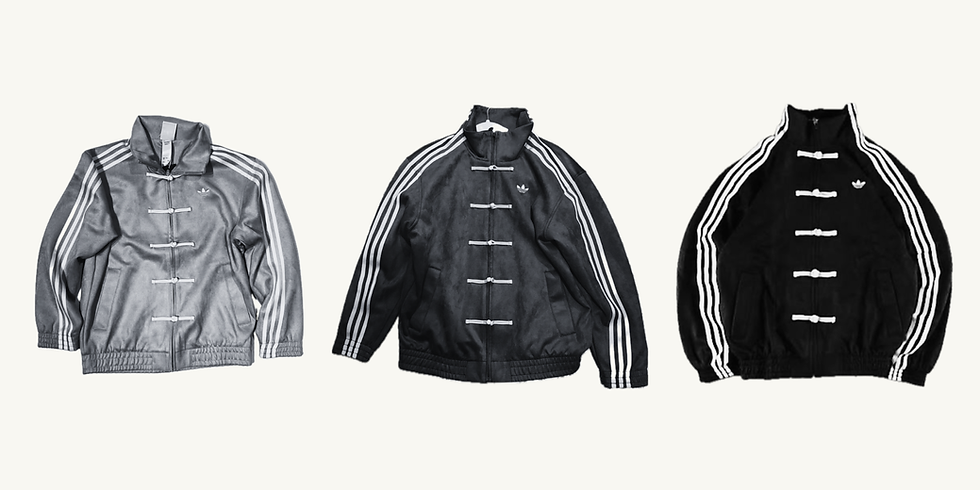
The Adidas Lunar New Year jacket launched in 2025: the track jacket reimagined with traditional Chinese pankou, or frog knot fastenings, in place of a zipper closure. Often referred to as a Tang style jacket, the design superimposes tangzhuang (昂装) onto Adidas’s classic tracksuit design. This jacket was made available in Asian markets in 2025, and was met with rabid enthusiasm; the jackets quickly sold out, sought by a barrage of overseas buyers via resale sites like eBay and Danezon. This year, Adidas launched a Lunar New Year collection in America on January 31st, 2026, in collaboration with CLOT, a Hong Kong based streetwear brand, likely due to the rabid popularity of the jacket with overseas buyers this previous year. It sold out on the Adidas website within a day.
Contemporary Western culture is experiencing perhaps an unprecedented level of sinophilia, from its cultural exports in food/drink and cinema to reverence for its growing infrastructure and economic power. The fusion of traditional ethnic clothing motifs with Western clothing has also become increasingly prevalent; plays on the Qipao have been popular in the West for over two decades. These garments are a type of magnet especially for diaspora audiences, for whom representational politics are often a chief concern. To see clothing visibly reference a minority ethnic culture in the West, especially if it was designed by a designer of one’s same ethnicity, can elicit an easy sense of recognition and belonging.
This particular jacket, often misattributed to the Tang Dynasty (618-907) due to the name tangzhuang, is instead a derivation of the Qing Dynasty magua (1619-1911), a waist length jacket consisting of five buttons and a high mandarin collar. The Zhongshan suit, a tunic-style suit consisting of four pockets, five buttons, and a high standing lapel, was introduced by Sun Yat Sen in the 1920s and marked an emergent and explicit Westernization of Chinese clothing. Chairman Mao would continue to popularize this suit, to the point that he eventually became its namesake. Mao era clothing wholly departed from traditionally Chinese design of the past in favor of austere and purely utilitarian construction. In the post-Mao era of economic liberalization, clothing from the West became even more prominent as the Mao suit appeared alongside Western style suits in gatherings of high ranking officials and politicians.
My father, who grew up in Mao-era China, tells me that the pankou buttons were long a relic even in his childhood. The closures on his shirts were the same round buttons that we see in the West today; this Qing era style of dressing has now been outdated for a century. Adidas’s adoption of this arbitrary, historically ambiguous style marks a shift in the landscape of modern ethnic dressing. The incorporation of decontextualized ethnic motifs here responds to the market substantiated appetites for clothing that announces its exoticism and visibly Others itself.
The popular culture of the West is no stranger to accusations of cultural appropriation, perhaps most aptly elucidated here in bell hooks’ essay “Eating the Other”: “Cultural appropriation of the Other assuages feelings of deprivation and lack that assault the psyches of radical white youth who choose to be disloyal to western civilization. Concurrently, marginalized groups, deemed Other … can be seduced by the emphasis on Otherness, by its commodification, because it offers the promise of recognition and reconciliation.” The ease with which contemporary Western youth adopts the mores of nonwhite cultures reflects a potent appetite to engage in disloyalty to American culture. The groups that are deemed Other enjoy a sense of pride that they embody this Otherness that’s ultimately unattainable by the dominant culture. hooks argues that when the political and cultural landscape shifts, “it invites a resurgence of essentialist cultural nationalism” that must manifest in a recognizable form, often evoking “a ‘glorious’ past.”
Pankou, this archaic element of Chinese dressing before Western influence, is nostalgically reinvoked and offered up to consumer culture. Though Asian Americans have rehashed the cultural appropriation conversation to a litany of goods that have been popularized in the West, this jacket manifests a more overlooked aspect of hooks’ analysis. Various designers involved with these Adidas campaigns are Chinese themselves, with the collection available in the United States being a collaboration with Canadian born Chinese actor Edison Chen. If Chinese people are the group that has been deemed Other as hooks says, there is no shortage of ethnically Chinese individuals that are eager to embody this Otherness. This line suffers no victims of cultural appropriation, ready and eager to capitalize on the appeal of Chinese culture via self-orientalization.
The literary critic Som Mai Nguyen writes of a tendency in diaspora literature that she terms “blunt force ethnic credibility,” in which the writer relies on linguistic coincidences in tonal languages and foreign words to essentially gesture towards some “exotic cultural knowledge” that only the writer is privy to. One levies the audience’s unfamiliarity with this language as an opening for imprecision; in X foreign language, “words are like spells,” two completely different words are just one with a double meaning, my foreign language is imbued with “ancient spiritual wisdom.” Diaspora writers’ eagerness to reaffirm adjacency to their exoticism as a means of claiming authority devolves into essentialism. Nguyen is especially frustrated with the careless imprecision of translated texts; white translators repeat these linguistic inaccuracies to the endorsement of diaspora writers– if the person of color has endorsed it, it gains automatic credibility with Western audiences. Nguyen cites Kristen Warner’s term “plastic representation”: the ecstasy at seeing “characters on screen who serve visual identifiers for specific demographics in order to flatten the expectation to desire anything more,” the identity politics of representation become gimmick and clichéd the more they are relied on.
A tracksuit is certainly a distinct entity to literature, but I cannot help but read the usage of this symbolism as the fashion analog to Nguyen’s prescription. These pankou adorn an iconic garment of the West with an explicit racialization that allows the consumer proximity to a foreign culture. In contemporary China, pankou are rather more prevalent at tourist attractions where people dress up in traditional hanfu for roleplays and photoshoots; this jacket strategically incorporates an archaic but recognizable design. Both the presence of these recognizable ethnic motifs and that these projects are helmed by ethnically Chinese individuals lend these campaigns credibility that may be unearned. White and ethnic individuals alike are prone to the allure of exoticism.
Perhaps I am cynical, and this is an earnest ode to the heritage of our long departed Chinese ancestors. The design simply reads as a gimmick to me, pandering to audiences’ appetites for exoticism and authenticity. Its rabid popularity is understandable, especially with the peculiar global appeal of anything recognizably Chinese in the current zeitgeist, but I sense that multinational corporations are just beginning to recognize the dollar value implications of commercialized ethnic clothing. As hooks’ essay denotes, the fashion industry “has also come to understand that selling products is heightened by the exploitation of Otherness.” The consumer market proves to be enthusiastically responsive to these formulaic fusions of East and West.
Chinese-American designers have long incorporated motifs of ethnic garb into new designs. Vivenne Tam’s design ethos is perhaps the most akin to the symbolism of the Adidas Tang Style jacket, incorporating various Chinese fabrics, patterns, and designs; qipao silhouettes, brocade embroidery, and her infamous MAO collection. The MAO collection can be considered in the legacy of Andy Warhol’s series of silkscreen paintings of the same name, which reimagined Mao’s formal portrait with bright colors and iconography that blur the line between celebrity worship and political propaganda. Tam’s collection, made in collaboration with Chinese artist Zhang Hongtu, similarly uses Mao's image as “a kind of mental therapy,” subverting his stern image and complex legacy with humor and playfulness in the wake of a sobering era of Chinese history. A subsequent collection reimagines the Mao suit in a print of Mao’s face in black and white, which Tam intended to symbolize both the "positive and negative effects Mao had on the Chinese culture.” This collection was met with strong backlash, her stores met by protestors and readers decrying insensitivity in Vogue.

While Vivienne Tam’s designs can be considered a precursor to this wave of fusion between commercial and ethnic clothing, her ethos is absent in the mass produced Adidas collections. This is not to say that culturally informed fashion design must be explicitly political; Chinese American designer Sandy Liang, perhaps known best for her Mary Jane pointe shoes and incorporation of bows into her designs, was first known for her nostalgic line of colorful fleeces inspired by the clothes worn by grandmas in Chinatown. There’s intention and emotion behind these designs, drawing from personal backgrounds and influences in the synthesis of something new. Designers in China and its diaspora today are also making names for themselves without explicit references to Chinese clothing of the past; Anna Sui’s works are inspired by various American subcultures from punk to bohemia, Uma Wang is known for her intricate usage of textiles and tailoring, Shushu/Tong for their feminine explorations of nostalgia and popular culture.
An increasingly globalized world undeniably allows for a greater exchange of ideas and traditions, clothing being one of many forms of culture manifesting multi-ethnic influences. Garments that express multiple cultural influences and inspirations and garments that incorporate ethnic symbolism to signal exoticism may not even be mutually exclusive; fashion, after all, is a base manifestation of performance. The existence of these Adidas collections are simply a predictable development of a tendency that has existed for decades in the design and manufacturing of clothing. If usage of decontextualized ethnic motifs by multi-national corporations ushers in a new market for clichéd cash grabs, it’s up to consumers to remain dubious of how meaningful these visual markers of exoticism really are. 🌀
Jade Gu is a writer and tech worker living in Brooklyn.


