I Got Every Inch of My Face Scanned

For science, obviously.

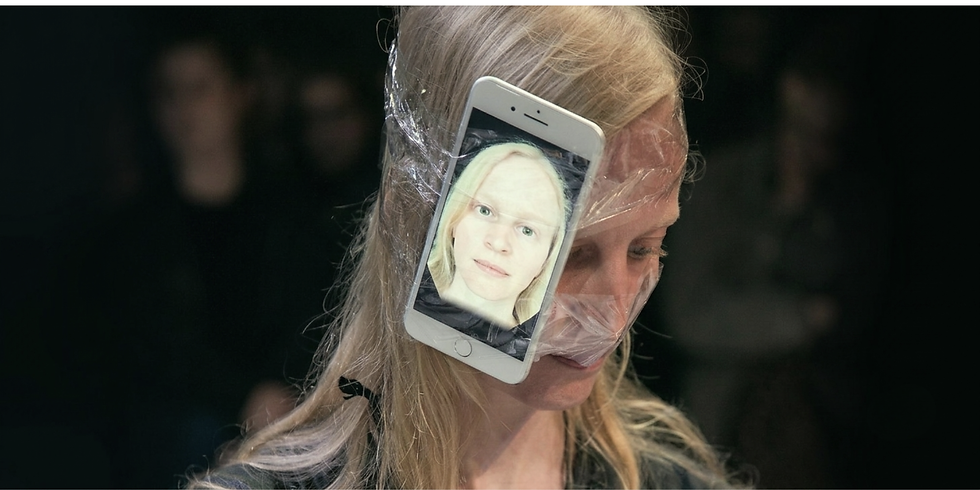
On a rainy, balmy, beautifully gray Saturday earlier this month, I nestled my face into a digital facial imaging process machine, or a VISIA. It looked about as Kronenbergian as it sounds: a Cross-polarized UV light swung a 360° axis around my head, photographing each visible inch of my face, from my widow’s peak to the tip of my chin. Every freckle, mole, wrinkle, rogue eyebrow hair, and melasma bouquet was accounted for, tallied, and systematized. There is something oddly serene in feeling a bright, white light tickle your cheekbones; in stepping out of your body and witnessing it objectively, without reaching for the balm of aesthetics or the relief-thrill of turning away from the mirror. This is my face. This is how it exists in the world. Now what?
I received the scan at the boutique aesthetics studio OVME. The business of aesthetics is undoubtedly controversial, and I’d finally gotten to the age (26) where I was thinking more about the way I looked less from a youthful mode of self-hatred and more from a desire for health. I worked out, I took a glut of supplements, I ate whole foods, I slathered and plumped my skin in a 12-step, meticulously designed routine. And while my skin wasn’t perfect — nor was I very much interested in perfection as an aesthetic or spiritual pursuit — I was interested in making sure my skin health was robust, and that I was doing what I could to not destroy our bodies’ largest organ.
When the scan was over, I’d been expecting vanity metrics — the summation of my face translated into raw data, designed for easy solutions: fill that pore, dissolve this wrinkle, temper that rosacea spatter. What I was not expecting was something no one, not even me, could’ve ever seen in a mirror.
Since time immemorial, women’s beauty rituals have been treated as frivolous, excessive, or fundamentally unserious. (Therein lies the rub — what’s so wrong with a bit of frivolity?) “All we are really seeking is a reliable way to show ourselves love when so many people around us are telling us we're worthy of little more than contempt,” says Kristin Iversen in NYLON. Skincare, despite its scientific bedrock, has continued to live in a weird space between legitimate healthcare and snake oil: buy this algae serum. Peel the topmost layer of your skin off. Look 15 forever. And while none of this is particularly new criticism, the ascendancy of dark horses in the skincare business — like Primally Pure, whose recent SPF campaign came under fire for claims that their products were “100% poison-free” — has made the question of skincare’s health legitimacy even more pertinent.
And while the merits of specific formulas, products, or branded campaigns can be endlessly debated, technological innovations in skincare are much harder to dismiss. “The future of aesthetics is no longer just about treating aging; it's about supporting healthy aging through regenerative medicine and evidence-based innovation,” says Iman Shamloul, PA-C. Imaging, diagnostics, and dermatology-backed formulations have risen considerably, like exome serums and Lancôme’s Cell BioPrint, which assesses skin-surface protein biomarkers to predict ingredient responsiveness. Being able to see how and why the skin, as a whole organ, changes, rather than simply waiting for a product to do its promised job (or reacting to what we can already see), is transformative. While this isn’t to say beauty = medicine, it is to say thus: as the skincare industry finds more footing in tried-and-true, quantifiable clinicality, rather than the subjective or decorative, other associated industries — like aesthetics — are following suit.
With clean, freshly washed skin, the VISIA scan broke down my skin into seven categories: wrinkles & fine lines; texture; surface spots; emerging brown spots; red areas; visible pores; clogged pores; and UV damage, and balanced my results against the global aggregate of anyone who’s ever had a VISIA scan. It was the last category that revealed what I couldn’t see: that I was in the bottom eighth percentile of sun damage in my age group. As a Southern WASP who spent most of her childhood running on the beach, I’ve always had very fair skin poxed with freckles, darkening and deepening in the summertime. The scan captured subterranean freckles and dots, invisible to the naked eye, secretly covering my entire face like a Pollock.
And while my first instinct was to brush this off (So what! I like my freckles!), I’d found out that the extent of that UV damage could, later on, aggravate my risk of sun cancer — disconcerting news, given I’ve had family members fight melanoma. “UV exposure accumulates over years, causing repeated DNA damage to skin cells. While the body is able to repair much of that damage, repeated sunburns and chronic UV exposure increase the likelihood of permanent DNA mutations over time, which can ultimately contribute to the development of skin cancers,” said Shamloul. And while this was just raw information, not a diagnosis, it showed me something I never would’ve known had I not received a scan.
After all this data, I then got a purely pleasurable, analysis-free beauty experience: a Hydrafacial. Using gentle, oddly satisfying suction, the esthetician glided the Hydrafacial device — a mini-vacuum with a hydro-dermabrasion tip — across my skin, extracting impurities and exfoliating dead skin cells I’d never be able to remove with an at-home exfoliant. Then came a layer of nourishing serums to replenish my barrier. As someone who holds a lot of lymphatic fluid in their face, I could feel every ounce drain from under the skin, flowing down my neck and toward my traps. And while I appreciated getting my lymph moving, it wasn’t like I hated that I also looked a lot more glowy and sculpted by the end, either. I don't think a facial needs to cure anything to be worthwhile or generative, whatever that means to you. But I also don't think the things we do for aesthetic reasons are inherently unserious.
If this were a morality play, I wouldn’t harangue you about how everyone deserves a facial (though I actually do think that, along with $10,000 and a good lip balm). What I would tell you, though, is that everyone deserves to have the kind of information a VISIA scan makes legible. If something relatively quick and harmless can illuminate something imperceptible — and if something like that can change how you think about your health — then beauty tech isn’t an indulgence, nor is it frivolous. It’s another way of understanding your body. OVME offers the VISIA scan free of charge, and I’ve urged the people in my life — both skincare devotees and agnostics — to consider one. Because while skincare will be thorny and complicated until quite possibly the end of time, your skin (and your health!) really doesn’t have to be, freckles and all. 🌀
Savannah Eden Bradley is a writer and fashion editor born in 1999. She is the Editor-in-Chief of the fashion magazine HALOSCOPE. Her first book, Ladies of the Canyon: Fashion and Fear in Los Angeles, is forthcoming from University of Texas Press. You can stalk her everywhere online @savbrads.